
In an era where green and low-carbon transformation has become a global industrial imperative, basalt fiber—a "green industrial material" derived from natural volcanic rock and renowned for its high strength and eco-friendly attributes—is experiencing rapid expansion. Sichuan Jumeisheng New Materials Technology Co., Ltd. (hereafter "Jumeisheng") is poised to redefine industry competition through its imminent launch of a 1,000-ton ultrafine basalt fiber demonstration project. This initiative not only fills the gap in large-scale ultrafine fiber production but also establishes a comprehensive "Resource + Technology + Ecosystem" value chain. As host of the concurrent "Ultrafine Basalt Fiber Scale Production and High-End Applications Summit," Jumeisheng is spearheading China’s historic shift from "scale expansion" to "high-end breakthrough" in basalt fiber innovation.
In the basalt fiber sector, raw material purity dictates product performance. Jumeisheng operates a dedicated basalt ore base with an annual extraction capacity of 500,000 tons. The ore consistently contains 52%–55% SiO₂ and 15%–18% Al₂O₃, providing superior "genetic material" for ultrafine fiber production. Compared to peers reliant on external procurement, Jumeisheng reduces raw material costs by ~70%. While the 2023 industry average ore price was ~¥380/ton, Jumeisheng’s integrated "self-owned mine + smart mining" model controls costs below ¥100/ton.
Critically, the mine operates with a "green foundation." The team employs an integrated "smart crushing + tailings recycling" process, enhanced by AI algorithms to optimize extraction, achieving ore utilization rates exceeding 98% and enabling "zero tailings" emissions. Traditional mining discards ~15% of ore as waste due to impurities—a practice that wastes resources and pollutes the environment. Jumeisheng’s spectral sorting technology repurposes ore with ≥48% SiO₂ for standard fiber production, maximizing resource efficiency and aligning with China’s "Dual Carbon" strategy.
The "final mile" from mine to fiber showcases Jumeisheng’s execution speed:

Jumeisheng’s proprietary manufacturing process yields basalt fibers with a tensile strength of 2,900 MPa and elastic modulus of 88 GPa—15% above industry averages and competitive with premium international brands. This leap stems from deep collaboration between Jumeisheng, Southeast University, and the National Basalt Fiber Engineering Center.
In early 2025, the partnership tackled the industry pain point: stability control. Traditional basalt fiber production suffers from strength variability (Coefficient of Variation, CV ~5%), undermining downstream composite reliability. Jumeisheng’s "gradient melting and drawing process" precisely regulates the cooling rate from 1,500°C to 1,300°C, reducing CV to <3%. This ensures uniform fiber properties, enabling high-end applications.
The company holds 5 invention patents, covering everything from raw material formulation to drawing equipment. Its "online ultrafine fiber diameter detection device" solves real-time measurement challenges, allowing immediate process adjustments to enhance consistency. This meticulous innovation ethos extends to commercial success: Jumeisheng’s basalt fiber-reinforced composites, adopted by leading automakers for EV interiors, reduce weight by 20% while increasing strength by 30%, boosting both range and safety. These materials are undergoing validation at multiple OEMs, signaling vast market potential.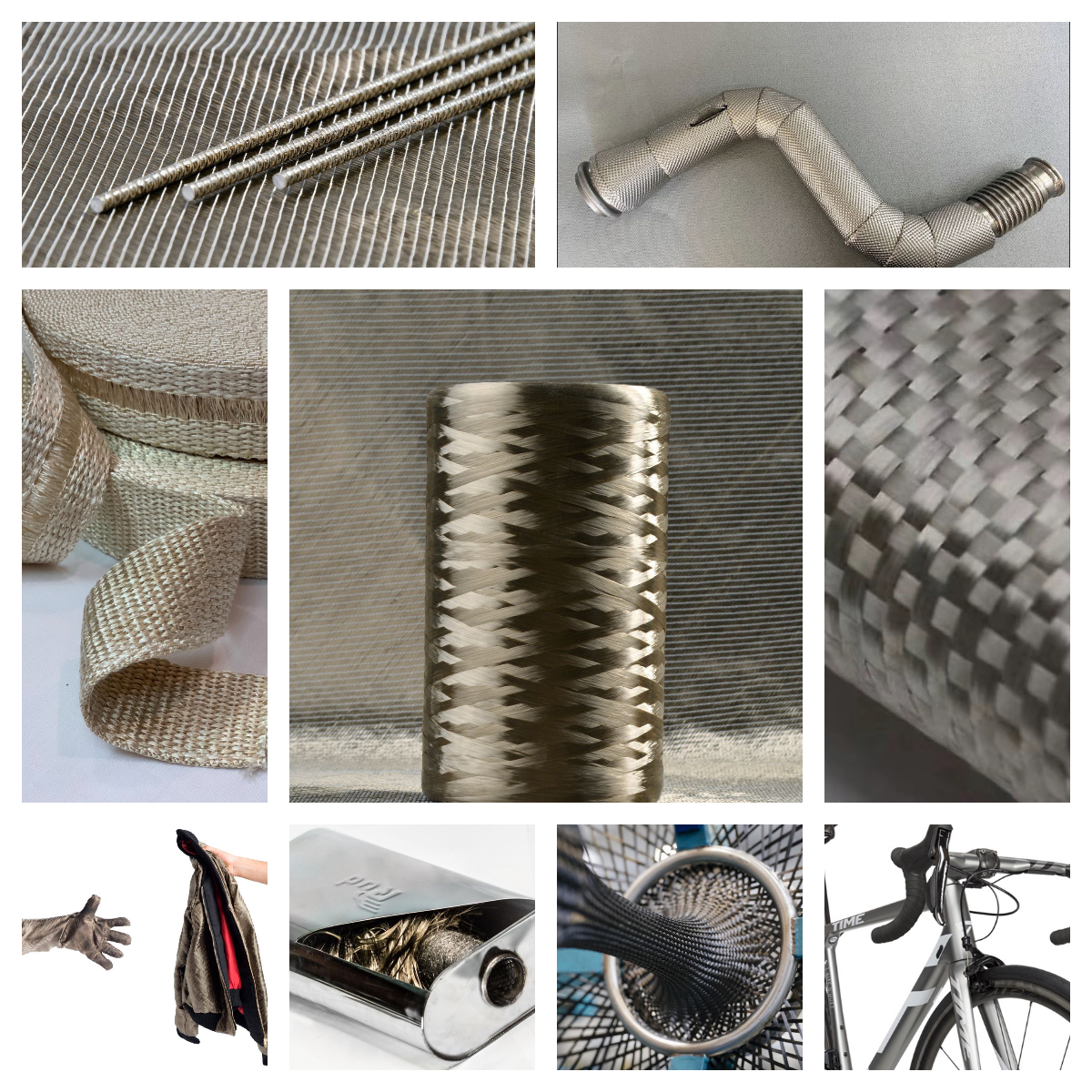
Basalt fiber’s value lies not just in production, but in application. Jumeisheng’s strategy shifts from fiber manufacturing to material solutions, targeting three high-value segments while building a "Technology + Capital" ecosystem.
Beyond automotive, Jumeisheng’s continuous basalt fiber boards target aircraft interior lightweighting. Traditional aluminum alloy components weigh ~2.8 kg/m²; Jumeisheng’s composite alternative weighs just 1.9 kg/m² while achieving UL94 V-0 flame resistance—meeting stringent aviation standards.
Addressing industrial flue gas treatment challenges, Jumeisheng developed a 400°C-resistant basalt fiber filter bag using "fiber surface modification + optimized needle-punched felt structure." It achieves 99.9% filtration efficiency and triples the lifespan of conventional bags. In tests under 400°C sulfurous gas, it operated reliably for 18 months—exceeding the 12-month client expectation.
Jumeisheng’s materials demonstrate unique value in demanding civil engineering contexts. As the sole supplier for Xiong’an New Area’s underground utility tunnel reinforcement, they overcome complex geology—high water tables and corrosive soils—setting a benchmark for durability.


